Wide Worlds Snapshots

We help you to see the Whole World in Snapshots, And you follow us in your likes and comments/.

Wide Worlds Snapshots

We help you to see the Whole World in Snapshots, And you follow us in your likes and comments/.

Wide Worlds Snapshots

We help you to see the Whole World in Snapshots, And you follow us in your likes and comments/.

Wide Worlds Snapshots

We help you to see the Whole World in Snapshots, And you follow us in your likes and comments/.

Wide Worlds Snapshots

We help you to see the Whole World in Snapshots, And you follow us in your likes and comments/.

Sunday, 23 November 2014

Jordan - The Wide Worlds Snaps

Ruler: King Abdullah II (1999)
Prime Minister: Abdullah Ensour (2012)
Land area: 34,286 sq mi (88,802 sq km);

total area: 34,495 sq mi (89,342 sq km) excludes West Bank
Population (2014 est.): 7,930,491 (growth rate: 3.86%); birth rate: 25.23/1000; infant mortality rate: 15.73/1000; life expectancy: 74.1
Capital and largest city (2011 est.): Amman, 1.179 million
Monetary unit: Jordanian dinar
National name: Al-Mamlaka al-Urduniya al-Hashimiyah
Current government officials
Languages: Arabic (official), English
Ethnicity/race: Arab 98%, Circassian 1%, Armenian 1%
Religions: Muslim 97.2% (official; predominantly Sunni), Christian 2.2% (majority Greek Orthodox, but some Greek and Roman Catholics, Syrian Orthodox, Coptic Orthodox, Armenian Orthodox, and Protestant denominations), Buddhist 0.4%, Hindu 0.1%, Jewish
National Holiday: Independence Day, May 25
Literacy rate: 95.9% (2011 est.)
Economic summary:
GDP/PPP (2013 est.): $40.02 billion; per capita $6,100.
Real growth rate: 3.3%.
Inflation: 5.9%.
Unemployment: 14% official rate; unofficial rate is approximately 30% (2011 est.).
Arable land: 1.97%.
Agriculture: citrus, tomatoes, cucumbers, olives, strawberries, stone fruits; sheep, poultry, dairy.
Labor force: 1.818 million; services 77.4%, industry 20%, agriculture 2.7% (2007 est.).
Industries: clothing, fertilizers, potash, phosphate mining, pharmaceuticals, petroleum refining, cement, inorganic chemicals, light manufacturing, tourism.
Natural resources: phosphates, potash, shale oil.
Exports: $7.914 billion (2013 est.): clothing, phosphates, fertilizers, potash, vegetables, pharmaceuticals.
Imports: $18.61 billion (2013 est.): crude oil, machinery, transport equipment, iron, cereals.
Major trading partners: U.S., Iraq, India, Saudi Arabia, China, Italy, Turkey, Indonesia (2012).
Communications:
Telephones: main lines in use: 435,000 (2012); mobile cellular: 8.984 million (2012).
Broadcast media: radio and TV dominated by the government-owned Jordan Radio and Television Corporation (JRTV) that operates a main network, a sports network, a film network, and a satellite channel; first independent TV broadcaster aired in 2007; international satellite TV and Israeli and Syrian TV broadcasts are available; roughly 30 radio stations with JRTV operating the main government-owned station; transmissions of multiple international radio broadcasters are available (2007).

Internet hosts: 69,473 (2012).
Internet users: 1.642 (2009).
Transportation: Railways: total: 507 km (2011).
Highways: total: 7,203 km; paved: 7,203 km; unpaved: 0 km (2011).
Ports and terminals: Al 'Aqabah.
Airports: 18 (2013).
International disputes: 2004 Agreement settles border dispute with Syria pending demarcation.In biblical times, the country that is now Jordan contained the lands of Edom, Moab, Ammon, and Bashan. Together with other Middle Eastern territories, Jordan passed in turn to the Assyrians, the Babylonians, the Persians, and, about 330 B.C. , the Seleucids. Conflict between the Seleucids and the Ptolemies enabled the Arabic-speaking Nabataeans to create a kingdom in southeast Jordan. In A.D. 106 it became part of the Roman province of Arabia and in 633–636 was conquered by the Arabs. In the 16th century, Jordan submitted to Ottoman Turkish rule and was administered from Damascus. Taken from the Turks by the British in World War I, Jordan (formerly known as Transjordan) was separated from the Palestine mandate in 1920, and in 1921, placed under the rule of Abdullah ibn Hussein.In 1923, Britain recognized Jordan's independence, subject to the mandate. In 1946, grateful for Jordan's loyalty in World War II, Britain abolished the mandate. That part of Palestine occupied by Jordanian troops was formally incorporated by action of the Jordanian parliament in 1950. King Abdullah was assassinated in 1951. His son Talal, who was mentally ill, was deposed the next year. Talal's son Hussein, born on Nov. 14, 1935, succeeded him.


Tags: The Wide Worlds Snaps, Jordan, Jordan - The Wide Worlds Snaps, Jordan beautifull country, Jordan pictures, Jordan cities, Jordan snaps,

Israel - The Wide Worlds Snaps

President-elect: Reuven Rivlin (2014)
Prime Minister: Benjamin Netanyahu (2009)
Land area: 7,849 sq mi (20,329 sq km);

total area: 8,019 sq mi (20,770 sq km)
Population (2014 est.): 7,821,850 (growth rate: 1.46%); birth rate: 18.44/1000; infant mortality rate: 3.98/1000; life expectancy: 81.28
Capital and largest city (2009 est.): Jerusalem, 791,000 Note: Israel proclaimed Jerusalem as its capital in 1950, but the U.S., like nearly all other countries, maintains its embassy in Tel Aviv.
Other large cities: Tel Aviv-Yafo 3.381 million; Haifa 1.054 million
Monetary unit: Shekel
Palestine, considered a holy land by Jews, Muslims, and Christians, and homeland of the modern state of Israel, was known as Canaan to the ancient Hebrews. Palestine's name derives from the Philistines, a people who occupied the southern coastal part of the country in the 12th century B.C.A Hebrew kingdom established in 1000 B.C. was later split into the kingdoms of Judah and Israel; they were subsequently invaded by Assyrians, Babylonians, Egyptians, Persians, Romans, and Alexander the Great of Macedonia. By A.D. 135, few Jews were left in Palestine; most lived in the scattered and tenacious communities of the Diaspora, communities formed outside Palestine after the Babylonian exile. Palestine became a center of Christian pilgrimage after the emperor Constantine converted to that faith. The Arabs took Palestine from the Byzantine empire in 634–640. Interrupted only by Christian Crusaders, Muslims ruled Palestine until the 20th century. During World War I, British forces defeated the Turks in Palestine and governed the area under a League of Nations mandate from 1923.


Tags: Israel Country, Israel pics, Israel Country Pictures, Israel - The Wide Worlds Snaps, The Wide Worlds Snaps, Israe, Israe beautifull pictures,

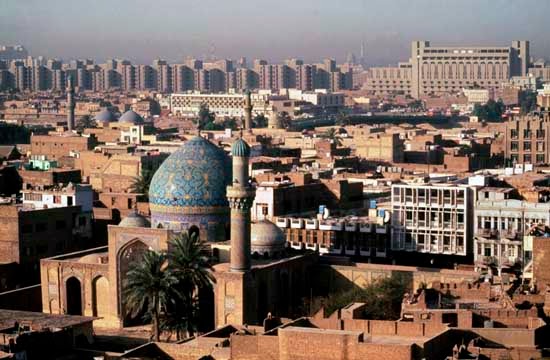
Iraq - The Wide Worlds Snaps

President: Fouad Massoum (2014)
Prime Minister: Haider al-Abadi (2014)
Land area: 167,556 sq mi (433,970 sq km)
Population (2014 est.): 32,585,692 (growth rate: 2.23%); birth rate: 26.85/1000; infant mortality rate: 37.53/1000; life expectancy: 71.42
Capital and largest city (2011 est.): Baghdad, 6.036 million
Largest cities: Mosul 1.494 million; Erbil 1.039 million; Basra 942,000; As Sulaymaniyah 867,000; Najaf 779,000
Monetary unit: U.S. dollar
From earliest times Iraq was known as Mesopotamia—the land between the rivers—for it embraces a large part of the alluvial plains of the Tigris and Euphrates rivers.An advanced civilization existed in this area by 4000 B.C. Sometime after 2000 B.C. , the land became the center of the ancient Babylonian and Assyrian empires. Mesopotamia was conquered by Cyrus the Great of Persia in 538 B.C. and by Alexander in 331 B.C. After an Arab conquest in 637–640, Baghdad became the capital of the ruling caliphate. The country was pillaged by the Mongols in 1258, and during the 16th, 17th, and 18th centuries was the object of Turkish and Persian competition.


Tags: Israel, Israel Country, Israel pics, Israel Country pics, The Wide Worlds Snaps, Iraq - The Wide Worlds Snaps, Iraq beautifull pictures,

Iran - The Wide Worlds Snaps

Chief of State: Ayatollah Ali Khamenei (1989)
President: Hassan Rouhani (2013)
Land area: 631,659 sq mi (1,635,999 sq km);
total area: 636,293 sq mi (1,648,000 sq km)
Population (2014 est.): 80,840,713 (growth rate: 1.22%); birth rate: 18.23/1000; infant mortality rate: 39/1000; life expectancy: 70.89
Capital and largest city (2011 est.): Tehran, 7.304 million
Other large cities: Mashhad 2.713 million; Esfahan 1.781 million; Karaj 1.635 million; Tabriz 1.509 million; Shiraz 1.321 million (2011)
Monetary unit: Rial
The region now called Iran was occupied by the Medes and the Persians in the 1500s B.C. , until the Persian king Cyrus the Great overthrew the Medes and became ruler of the Achaemenid (Persian) Empire, which reached from the Indus to the Nile at its zenith in 525 B.C. Persia fell to Alexander in 331–330 B.C. and a succession of other rulers: the Seleucids (312–302 B.C. ), the Greek-speaking Parthians (247 B.C. – A.D. 226), the Sasanians (224–c. 640), and the Arab Muslims (in 641). By the mid-800s Persia had become an international scientific and cultural center. In the 12th century it was invaded by the Mongols. The Safavid dynasty (1501–1722), under whom the dominant religion became Shiite Islam, followed, and was then replaced by the Qajar dynasty (1794–1925).During the Qajar dynasty, the Russians and the British fought for economic control of the area, and during World War I, Iran's neutrality did not stop it from becoming a battlefield for Russian and British troops. A coup in 1921 brought Reza Kahn to power. In 1925, he became shah and changed his name to Reza Shah Pahlavi. He subsequently did much to modernize the country and abolished all foreign extraterritorial rights.


Tags: Iran Country, Iran Pics, Iran Pictures, Iran Cities Pics, Iran - The Wide Worlds Snaps, The Wide Worlds Snaps, Iran, Iran beautifull pictures,

Sunday, 16 November 2014

Brunei - The Wide Worlds Snaps

Brunei Darussalam
Sultan: Haji Hassanal Bolkiah (1967)

Land area: 2,035 sq mi (5,271 sq km);
total area: 2,228 sq mi (5,770 sq km)
Population (2012 est.): 395,027 (growth rate: 1.7%); birth rate: 18/1000; infant mortality rate: 11.8/1000; life expectancy: 75.9; density per sq km: 72
Population (2012 est.): 408,786 (growth rate: 1.69%); birth rate: 17.74/1000; infant mortality rate: 11.15/1000; life expectancy: 76.37; density per sq km: 72
Capital and largest city (2009 est.): Bandar Seri Begawan, 78,000
Other large cities: Kuala Belait 27,800, Seria 23,400
Monetary unit: Brunei dollar
The Sultanate of Brunei ruled during the fourteenth to the sixteenth century. Its territory allegedly covered the northern part of Borneo and the southern Philippines. European influence gradually brought an end to this regional power. Later, there was a brief war with Spain, in which Brunei was victorious. The decline of the Bruneian Empire culminated in the nineteenth century when Brunei lost much of its territory to the White Rajahs of Sarawak, resulting in its current small landmass and separation into two parts. Brunei was a British protectorate from 1888 and a British dependency in 1905. Japan occupied Brunei during World War II; it was liberated by Australia in 1945.


Tags: Brunei, Brunei country, Brunei beauty, Brunei - The Wide Worlds Snaps, The Wide Worlds Snaps, Brunei beautifull pictures,